2026 How to Choose the Right AC Motor for Your Application?
Choosing the right AC motor for your application can be challenging. Many factors come into play. Different applications have unique demands. The correct AC motor can enhance efficiency and performance.
Consider the power requirements of your application. A motor with too low power may struggle. If the power is too high, it leads to wasted energy. Efficiency ratings also matter significantly. Higher efficiency means lower operating costs in the long run.
Remember to think about the environment. Will your motor face extreme temperatures? Dust and moisture levels can affect performance. Proper selection involves balancing these elements. It’s not just about picking any AC motor; it’s about finding the perfect fit. A poorly chosen motor can result in operational issues and costly repairs.
Understanding the Basics of AC Motors and Their Types
When selecting the right AC motor, understanding the basics is crucial. AC motors are powered by alternating current. This stands in contrast to DC motors, which rely on direct current. There are two main types of AC motors: synchronous and induction. Synchronous motors run at a constant speed, while induction motors vary depending on load.
Induction motors are more common in industrial applications due to their robustness. They are often easier to maintain but may not be suitable for all uses. For instance, if precise speed control is imperative, a synchronous motor might be better. Each type has its own advantages and challenges, which can be confusing.
Your specific application will dictate the best choice. Consider factors like torque requirements, operational speed, and environmental conditions. It's important to reflect on these aspects. Sometimes, the less obvious option can be the best. Take your time to research and weigh your options carefully.
2026 AC Motor Types Comparison
This chart compares different types of AC motors based on their efficiency ratings and typical use cases. The data showcases the average efficiency of Synchronous, Induction, and Universal motors.
Assessing Key Performance Specifications for Your Application
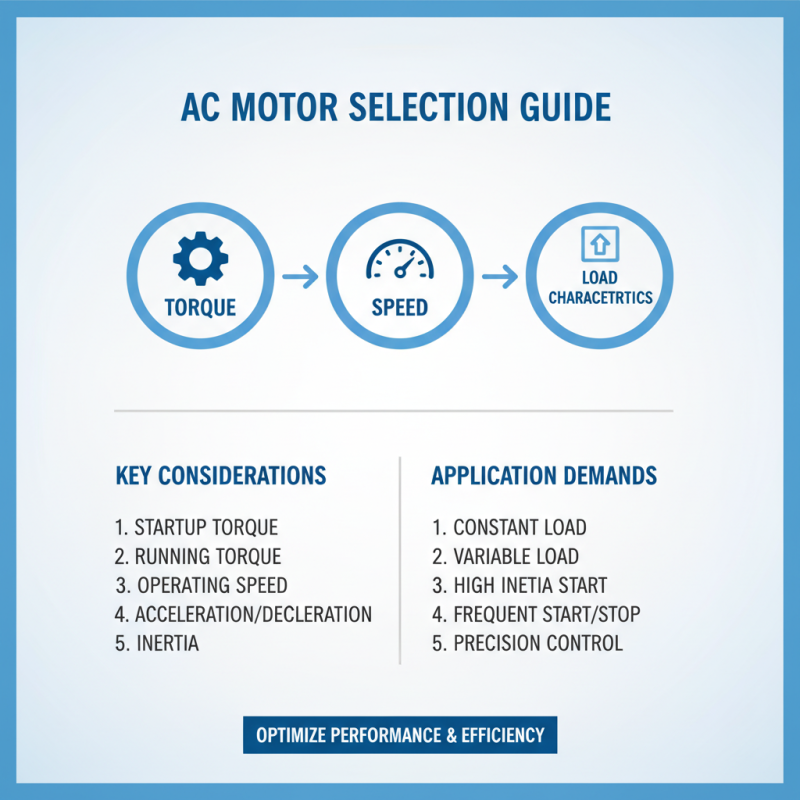
Choosing the right AC motor involves careful assessment of various performance specifications. Start by evaluating the required torque and speed. These two factors are crucial for ensuring the motor meets application demands. Consider the load characteristics, too. A simple application may require less torque than a startup application with high inertia.
Energy efficiency is another key specification. Pay attention to the power rating and efficiency class. Low efficiency can lead to higher operational costs, impacting long-term performance. Yet, efficiency ratings can be confusing. Sometimes, a seemingly small difference in efficiency means a significant cost difference over time.
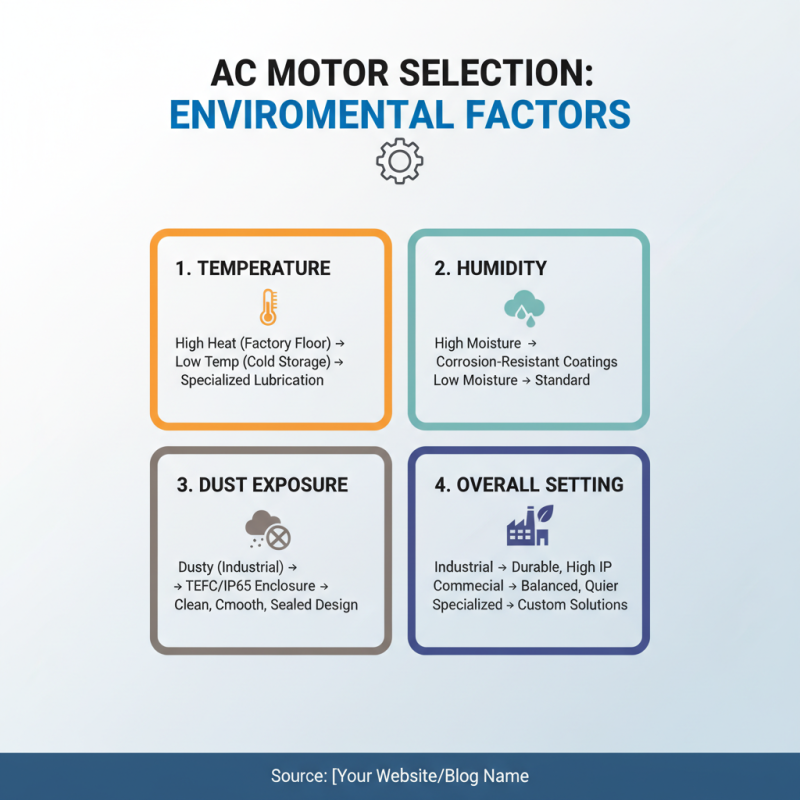
Also, think about the environment. Motors may need to operate in harsh or variable conditions. Resistance to dust, moisture, and temperature variations must be taken into account. Choosing a standard motor without these features could lead to premature failures. Reflecting on the elements that matter most to your application will lead to more informed decisions. Don't underestimate the importance of application-specific needs.
Evaluating Environmental Conditions and Operational Requirements
When selecting the right AC motor, evaluating environmental conditions is critical. Factors like temperature, humidity, and exposure to dust can significantly affect motor performance. An industrial setting may require more robust options. A factory floor might have high heat, while a clean room demands a different solution.
Tips: Consider the location of the motor. Is it indoors or outdoors? Will it face moisture or chemicals? These aspects will guide your decision.
Next, think about operational requirements. How often will the motor run? Will it need to handle sudden starts and stops? Frequent operation may require a motor with higher durability.
Tips: Always review load specifications. A mismatch can lead to inefficiency or damage. Also, evaluate energy consumption. An inefficient motor will increase costs over time. This reflection on needs can lead to better choices, despite the complexity involved.
Cost Analysis: Budgeting for AC Motor Selection
When budgeting for AC motor selection, it’s essential to consider both upfront and ongoing costs.
A 2021 report by the International Electrotechnical Commission suggests that
motor efficiency significantly impacts energy costs over time. For example, a motor with an efficiency of
95% may save around $35,000 over its lifespan,
compared to a 90% efficient motor. These savings can
influence budget allocation significantly.
Initial purchase prices can vary widely. Basic models might cost around $200, while more advanced
options can exceed $1,000. This disparity often leads to challenges for decision-makers.
Are the energy savings worth the higher initial expense? The answer is not straightforward.
Maintenance costs must also be included. According to industry data, nearly 80% of motor failures
stem from inadequate maintenance. Regular upkeep can cost about 10-20% of the
total motor price per year. Skipping these costs could lead to unpredictable expenses. Reflecting on this,
one must consider whether the focus should be solely on the lowest purchase price. Balancing costs with
performance can lead to smarter decisions.
Future Trends in AC Motor Technology and Their Implications
The future of AC motor technology is evolving rapidly. Innovations are focusing on energy efficiency and smart features. These advancements aim to meet stringent environmental standards. However, not every new technology is perfect; some designs can be complex and challenging to implement.
Recent trends show an increase in the use of variable frequency drives. This integration allows better control of motor speed and torque. It enhances performance in various applications, but it can also add to initial costs. Businesses must weigh these factors carefully. Integration can be complicated, requiring skilled technicians for setup and maintenance.
Moreover, the push for sustainable solutions is affecting AC motor designs. Manufacturers are exploring advanced materials, improving heat resistance and durability. New manufacturing processes may lead to waste reduction. Still, the long-term reliability of these materials must be tested. Each innovation presents potential challenges that require reflection and careful consideration. The right choice of AC motor will depend on specific requirements and future trends.
2026 How to Choose the Right AC Motor for Your Application? - Future Trends in AC Motor Technology and Their Implications
| Application |
Motor Type |
Power Rating (kW) |
Efficiency Class |
Control Method |
Future Trends |
| Pumps |
Induction Motor |
15 |
IE3 |
VFD |
Increasing use of IoT |
| Fans |
Permanent Magnet Motor |
5 |
IE4 |
Direct Control |
Smart motor control systems |
| Conveyors |
Synchronous Motor |
10 |
IE3 |
Field Oriented Control |
Integration with AI |
| Agricultural Equipment |
Brushless DC Motor |
7.5 |
IE4 |
Sensorless Control |
Enhanced energy recovery |
| HVAC Systems |
Dual-Voltage Motor |
20 |
IE3 |
PWM Control |
Adoption of renewable energy |