Essential Tips for Choosing the Right 3V DC Motor for Your Project?
Choosing the right DC Motor 3V for your project can be a daunting task. With numerous options available, understanding your specific needs is crucial. Tom Johnson, a leading expert in electric motor technology, notes, "A well-chosen motor can make or break your project's success." This underscores the importance of careful selection.
When looking for a DC Motor 3V, consider key factors such as torque, speed, and efficiency. Each of these elements influences your project's overall performance. For example, if your application requires a high starting torque, a standard motor may not suffice. Instead, you might need a specialized design. Many projects fail due to improper motor choice, leading to inefficiencies and unsatisfactory results.
Take the time to research and reflect on your options. Look into customer reviews and assessments to gauge reliability. Ensure that the motor you choose aligns with your goals. Ultimately, picking the right DC Motor 3V requires both knowledge and trial and error. Embrace the learning process as part of your project's journey.

Understanding the Basics of 3V DC Motors
When selecting a 3V DC motor, it's crucial to understand its fundamentals. These motors often drive small applications in robotics, toys, and automated devices. A robust understanding of torque, RPM, and power consumption is essential. According to industry reports, nearly 30% of failures in motor applications arise from improper motor selection.
Torque is a key performance metric in DC motors. It's the force that causes rotation. For instance, a motor delivering 100 mNm of torque may not suffice for high-load applications. RPM indicates how fast the motor spins. Most 3V DC motors operate between 1000 to 5000 RPM. However, different projects may require varying RPMs, necessitating careful consideration of your application needs.
Sizing the motor is equally important. A too-small motor can lead to overheating and failure. Conversely, an oversized motor may waste energy. Many hobbyists overlook these factors. According to a study from the Electric Motor Association, about 40% of users do not match their motor choice to their project’s load requirements. It’s vital to balance these aspects to ensure reliability and efficiency.
Essential Tips for Choosing the Right 3V DC Motor for Your Project
| Parameter |
Description |
Examples |
| Voltage |
Operating voltage range for the motor, typically around 3V. |
3V nominal, can vary between 2.5V to 4V |
| Current Rating |
Maximum current the motor can draw during operation. |
Approx. 100mA to 1A |
| Speed |
Rotational speed measured in RPM (Revolutions per Minute). |
5000 to 10000 RPM |
| Torque |
The rotational force produced by the motor. |
1 to 5 Ncm |
| Form Factor |
Physical size and shape of the motor. |
Miniature, standard |
| Efficiency |
Ratio of useful output power to input power. |
60% - 90% |
Key Specifications to Consider When Selecting a 3V DC Motor
When selecting a 3V DC motor, several key specifications are crucial for ensuring optimal performance. Motor speed is one such specification. It is typically measured in revolutions per minute (RPM). A higher RPM generally means faster operation but can lead to reduced torque. Balance is essential based on your project's demands.
Another important factor is the torque rating. This indicates how much force the motor can exert. When your application requires lifting or moving heavy objects, adequate torque becomes vital. Test different models to see which provides the necessary power without overloading. Also, consider the motor's current rating. It determines how much current the motor will draw under different conditions. Higher currents can lead to heat buildup and may affect motor lifespan.
Finally, think about size and weight. Physical dimensions can directly impact your project design. A compact motor may fit better in limited spaces. However, it might compromise power. It's a trade-off between size and efficiency. Careful evaluation of these specifications will aid in making a more reliable choice for your project.
Assessing Power Requirements for Your Project's 3V DC Motor
When selecting a 3V DC motor, it is crucial to assess your project's power requirements. Start by determining the load your motor needs to handle. Consider the weight of your device and the force required to move it. This helps in selecting a motor that can efficiently meet the demands.
Another aspect is understanding the power supply. Verify the available voltage and current. A motor might perform poorly if the power supply is inadequate. Knowing your power source ensures you choose a compatible motor.
**Tip:** Always calculate the maximum load. It provides clarity on the motor's specifications you need.
Also, think about the speed required for your application. Different motors offer varying RPMs, so choose one that matches your project’s needs. Remember, too fast or too slow can lead to inefficiencies.
**Tip:** Test your motor choice under load. This helps identify performance issues early. Reflect on the results and adjust if necessary.
Evaluating Motor Efficiency and Speed Ratings
Motor efficiency and speed ratings are critical factors when selecting a 3V DC motor for your project. According to a report by the Electric Motor Association, a higher efficiency rating indicates less energy loss, which can significantly reduce operational costs. For example, motors with efficiency ratings above 80% are often considered superior. Such motors convert most of the electrical energy into mechanical energy, enhancing overall performance.
Speed ratings provide insight into motor capabilities. A typical 3V DC motor can operate at speeds ranging from 1000 to 3000 RPM. Choosing the right speed depends on your application. Some applications may require high speeds, while others benefit from lower speeds with greater torque. It's essential to match the motor speed to the device's needs.
Consideration of these factors helps ensure that the motor meets the specific demands of your project. However, selecting the ideal motor can be challenging. You may find discrepancies in published specifications versus real-world performance. Conducting practical tests can help refine your decision, revealing how a motor truly performs under load conditions. Understanding both efficiency and speed ratings ultimately leads to better project outcomes.
Performance Comparison of 3V DC Motors
This chart compares the efficiency and speed ratings of different 3V DC motor models, which are crucial factors to consider when choosing a motor for your project. Higher efficiency means less energy loss, while higher speed ratings indicate better performance for specific applications.
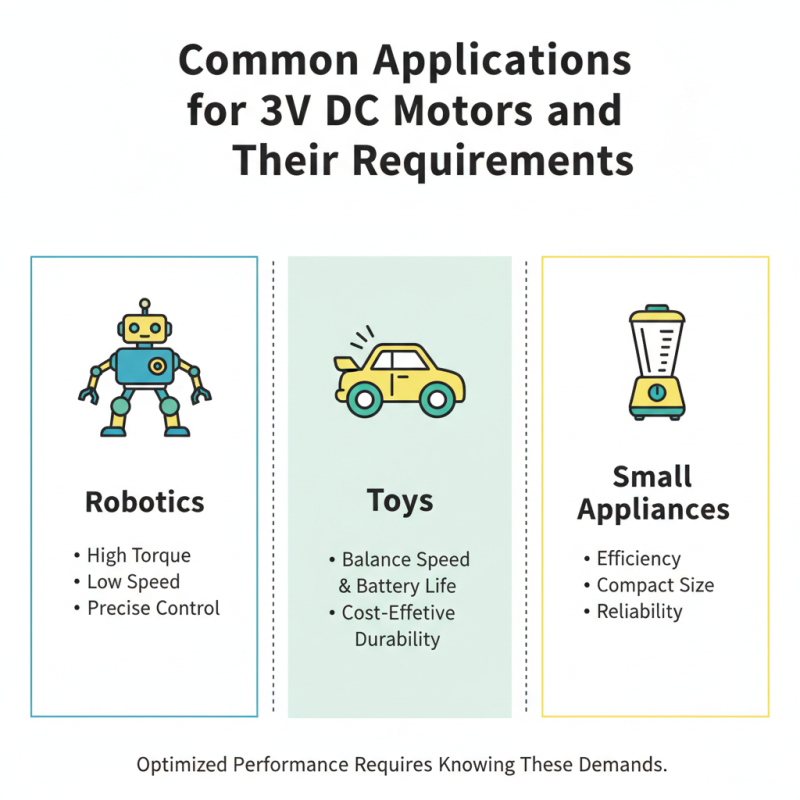
Common Applications for 3V DC Motors and Their Requirements
When selecting a 3V DC motor, understanding its applications is critical. Commonly, these motors are used in robotics, toys, and small appliances. Each application has unique demands. For instance, a hobby robot may require a high torque at a low speed, while a toy must balance speed and battery life effectively. Knowing these requirements is essential for optimal performance.
Research indicates that approximately 70% of engineers prioritize torque specifications when designing systems with 3V DC motors. Likewise, power consumption is a key focus, affecting overall efficiency. Data shows that motors running below their rated voltage may experience reduced torque output. This ultimately impacts the desired performance, leading to potential project delays.
In addition, environmental factors must be considered. Operating temperature and humidity levels can influence motor efficiency. Some applications may need motors that withstand extreme conditions. Engineers must weigh these factors carefully. Overlooking them could lead to mechanical failures. Understanding these nuances enhances decision-making when choosing the right motor for specific needs.