Leave Your Message

China Top BLDC Motor Manufacturers How to Choose?

China has become a major production base for brushless DC motor systems, serving appliances, HVAC equipment, medical devices, robotics, and electric mobility. A Bldc Motor can look simple from outside, yet its performance depends on winding quality, magnet grade, bearings, controller matching, and thermal design.

The International Energy Agency reports that motor-driven systems consume roughly half of global electricity. This figure explains why efficiency deserves more attention than purchase price. The IEA Global EV Outlook 2024 also recorded nearly 14 million electric car sales in 2023, increasing demand for compact, efficient motor technologies. These trends create strong opportunities for Chinese manufacturers, but they also raise the selection standard.

A reliable supplier should provide measured efficiency curves, torque-speed data, insulation details, noise results, and endurance-test records. Look for evidence from ISO 9001 systems, relevant IEC testing, and product certifications required in the target market. Factory experience matters. Can the supplier explain its magnet supplier, balancing process, winding temperature, and controller compatibility?

A low quotation can be attractive. It can also conceal thinner materials, weaker testing, or inconsistent batches. No single market report can identify the best factory for every application. That is the difficult part. Buyers should compare samples, audit production controls, verify test reports, and examine after-sales response before approving mass production. The right choice balances efficiency, reliability, customization, delivery capacity, and total operating cost—not merely the lowest unit price.
China Top BLDC Motor Manufacturers How to Choose?

What Is a BLDC Motor and Why Does the Manufacturer Matter?

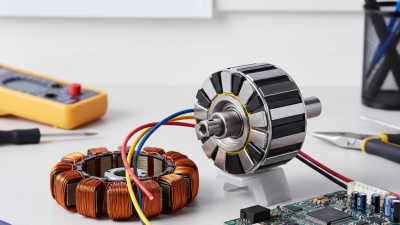
A brushless DC motor uses electronic commutation instead of physical brushes. Permanent magnets sit on the rotor, while energized stator windings create rotating magnetic force. A controller switches current through these windings at the correct position. Hall sensors may provide rotor feedback, while sensorless designs estimate position from back electromotive force.

This structure reduces brush wear and supports quiet, efficient operation. However, performance depends on more than the motor label. In a real test, a motor may run smoothly at 1,500 rpm but overheat near a sealed gearbox. Winding resistance, magnet strength, bearing quality, and heat paths all matter. Small design choices become visible through vibration, temperature rise, and starting behavior.

The manufacturer matters because consistent production protects those details. A reliable supplier should provide torque-speed curves, efficiency data, insulation ratings, noise measurements, and tested operating limits. Ask how winding balance is checked and how rotor magnets are secured. Request sample testing under your actual voltage, load, duty cycle, and ambient temperature. Do not rely only on a polished datasheet.

A low price can be attractive.

Yet weak quality control may cause uneven torque or early bearing failure. Certification documents also deserve careful review, because paperwork alone cannot prove field reliability. Good technical support should explain failures honestly and adjust the design when test results disagree with expectations. Even experienced buyers can overlook cable heating or controller compatibility. That is where a practical manufacturer often makes the difference.
How to Assess China’s BLDC Motor Manufacturing Capabilities

China’s BLDC motor capability should be judged through measurable process evidence, not factory size. The IEA reports that electric motor systems consume roughly 40% of global electricity. Efficiency is therefore a practical purchasing concern. Ask manufacturers for measured efficiency curves, torque-speed data, and test conditions.

A capable supplier should control magnet insertion, stator winding, balancing, and rotor inspection. Request records from end-of-line testing. These should include no-load current, winding resistance, vibration, noise, and temperature rise.

IEC 60034-30-1 provides a useful efficiency classification framework. However, BLDC products often need additional controller and system-level tests. Check sensor accuracy, startup behavior, thermal protection, and electromagnetic compatibility.

Look closely at production consistency. China’s large electronics supply base can support automated winding, digital traceability, and fast tooling changes. Yet capacity alone proves little. The U.S. Department of Energy’s Motor Systems Market Assessment links motor efficiency with system design and operating conditions.

Ask for samples from different production dates, not one perfect unit. Review failure analysis, incoming-material controls, and corrective-action records. ISO 9001 certification helps, but it cannot replace technical audits.

I would also verify magnet grades independently. Some specifications look impressive on paper, then weaken under heat. That is an uncomfortable detail, but it matters. Test prototypes under the real load, duty cycle, voltage, and ambient temperature before approving volume production.

Which Technical Specifications Should Buyers Compare?

When comparing China BLDC motor manufacturers, buyers should begin with operating conditions, not catalog claims. Define the required voltage, continuous torque, peak torque, speed range, and duty cycle. A motor rated at 2,000 rpm may lose torque under real load.

Check the winding design and Kv value together. Kv indicates speed per volt, but it does not confirm usable power. Compare efficiency at your actual working point, such as 48 V, 1,500 rpm, and 6 Nm. Request torque-speed curves, current limits, and temperature-rise data. Small details matter. A 10°C difference can affect service life. Also review rotor inertia, starting torque, bearing type, shaft tolerance, and allowable radial load.

Control compatibility needs equal attention. Confirm Hall sensor spacing, encoder resolution, phase wiring, and controller communication. For dusty or wet equipment, inspect the IP rating and sealing method. Ask how noise is measured, including distance, speed, and load. Otherwise, two test reports may look similar but describe different conditions. I have seen buyers focus on maximum efficiency, then discover poor performance during low-speed starts. That mistake is easy to repeat. Reliable suppliers should provide sample test records, inspection standards, and traceable production data. Before placing a large order, run a sample under the real load, ambient temperature, and mounting arrangement. A perfect datasheet cannot replace that test.

China Top BLDC Motor Manufacturers How to Choose? - Which Technical Specifications Should Buyers Compare?

Technical Specification Entry-Level Reference Industrial Reference High-Performance Reference What Buyers Should Verify
Rated Voltage 12–24 VDC 24–48 VDC 48–96 VDC Confirm nominal voltage, allowable voltage range, polarity protection, and compatibility with the selected drive.
Rated Output Power 10–100 W 100 W–2 kW 2–10 kW Compare continuous power at the specified ambient temperature, mounting position, and cooling method.
Rated Speed 1,500–4,000 rpm 1,500–6,000 rpm 3,000–10,000 rpm Check the speed-torque curve, maximum mechanical speed, overspeed limit, and speed regulation under load.
Continuous Rated Torque 0.03–0.30 N·m 0.30–6 N·m 6–30 N·m Use continuous torque for normal operation and verify peak torque duration, duty cycle, and thermal limits.
Peak Torque 1.5–2 times rated torque 2–3 times rated torque Up to 3–4 times rated torque Confirm the permitted peak duration, current limit, acceleration profile, and thermal recovery time.
Motor Efficiency 70–82% 82–92% 90–95% Compare efficiency at the actual operating point, not only the maximum published value; request test conditions.
Feedback and Commutation Hall sensors or sensorless control Hall sensors, encoder, or resolver options High-resolution encoder or resolver with FOC Check sensor type, electrical angle, feedback resolution, starting torque, and low-speed stability.
Speed Regulation Typically ±1–3% with closed-loop control Typically ±0.2–1% Typically better than ±0.2% with encoder feedback Specify load variation, speed range, control mode, and measurement method.
Winding and Pole Configuration 3-phase; commonly 2–8 poles 3-phase; commonly 4–14 poles Application-specific winding and pole count Request back-EMF waveform, winding resistance, inductance, torque constant, and phase sequence.
Insulation System Class B, 130°C Class F, 155°C Class H, 180°C Verify insulation class, dielectric withstand test, insulation resistance, and inverter-duty suitability.
Protection Rating IP20–IP44 IP54–IP65 IP65–IP67 Confirm the rating under IEC 60529 and check whether it applies to the motor, connectors, and cable exits.
Operating Temperature 0 to 40°C ambient −10 to 50°C ambient −20 to 60°C ambient Check derating curves, winding temperature, magnet temperature, storage temperature, and condensation limits.
Cooling Method Natural convection Natural convection or external fan Forced-air or liquid cooling Compare continuous ratings with the same cooling condition and installation orientation.
Vibration and Noise Application-dependent Typically 45–65 dB(A) at 1 m Typically below 55 dB(A) at 1 m with optimized control Request noise spectrum, vibration grade, test speed, test distance, and mounting conditions.
Bearing Arrangement Shielded or sealed ball bearings Sealed ball bearings selected for rated load Application-specific bearings with enhanced life rating Compare bearing type, calculated L10 life, radial and axial load capacity, grease, and maintenance requirements.
Mechanical Life Target 5,000–10,000 operating hours 10,000–20,000 operating hours 20,000–40,000+ operating hours Verify the duty cycle, load, speed, ambient temperature, and definition of service life.
Applicable Standards Basic electrical and safety testing IEC 60034-1 and IEC 60529 reference testing IEC 60034 series, EMC testing, and application-specific approvals Request current test reports, declarations, traceability records, and the exact standard revision used.
Production Consistency Basic end-of-line testing Routine electrical, dimensional, and no-load testing Full traceability, calibrated test systems, and process capability monitoring Compare control plans, sampling levels, calibration records, incoming-material inspection, and batch traceability.
Customization Capability Standard frame and shaft options Customized winding, shaft, connector, and mounting flange Joint electromagnetic, thermal, mechanical, and firmware optimization Evaluate prototype lead time, engineering support, sample validation, tooling ownership, and change-control procedures.
Buyer Evaluation Note: The numerical bands above are general reference ranges for common low-voltage BLDC motor applications, not quotations or guaranteed performance values. Final comparison should use identical voltage, speed, torque, ambient temperature, cooling, duty cycle, and test methods.

How to Verify Quality, Customization, and Production Reliability

Choosing a BLDC motor manufacturer requires more than checking a catalog rating. The International Energy Agency estimates that electric motor systems consume nearly half of global electricity. Small efficiency errors can therefore become expensive over long operating hours. Ask for measured efficiency, torque-speed curves, thermal-rise records, and end-of-line test results. Numbers matter.

Quality verification should follow recognized requirements, including IEC 60034 testing principles where applicable. Inspect winding resistance, back-EMF balance, bearing noise, vibration, insulation strength, and temperature rise. A reliable supplier should provide serial-level traceability and calibrated equipment records. Request samples from normal production, not laboratory prototypes. Test the weak points. A perfect sample proves little if process variation remains unknown.

Customization also needs engineering evidence. Confirm the duty cycle, load inertia, mounting tolerance, controller compatibility, IP rating, magnet grade, and expected service life. The U.S. Department of Energy’s motor-system assessments identify meaningful savings through correct sizing, controls, and system optimization. Ask the manufacturer to validate those choices through load testing and repeated thermal cycles. Production reliability depends on capacity planning, incoming-material inspection, process capability data, and contingency plans for critical components. ISO 9001 certification can support confidence, but it cannot replace an on-site audit. This is where many evaluations become too optimistic. Supplier promises are useful; repeatable records are stronger.

How to Select the Best China BLDC Motor Manufacturer for Your Needs

How to Select the Best China BLDC Motor Manufacturer for Your Needs

Selecting a China BLDC motor manufacturer requires more than comparing unit prices. Start with your application details: voltage, torque, speed range, duty cycle, noise limits, and installation space. A supplier should respond with clear motor curves, drawings, tolerance data, and testing conditions. Vague specifications create expensive surprises later.

Ask for samples from the same production line used for mass orders. Test starting torque, temperature rise, vibration, efficiency, and controller compatibility. A reliable manufacturer should explain its winding process, magnet selection, balancing method, and final inspection records. Check whether it controls key components or depends heavily on changing subcontractors. Stable engineering communication matters too. Can the team understand a small design change without repeated confusion?

Factory visits or live video audits can reveal practical details. Look at testing equipment, component storage, traceability labels, and rejected parts. Quality certificates help, but they do not replace actual evidence. Request a pilot order with measurable acceptance criteria and documented corrective actions. One mistake I would avoid is choosing the lowest quote before checking lifetime performance. It may save money briefly. It may also increase service costs.

Consider production capacity, tooling ownership, packaging, lead time, and after-sales support. A technically strong supplier may still be unsuitable if it cannot handle your forecast. Ask difficult questions early. Keep written records. Some assumptions will be wrong, and careful review should expose them before production begins.