Leave Your Message
Finding a reliable supplier in China’s Motor Work industry requires more than comparing prices. A professional buyer must examine engineering ability, production controls, and long-term service capacity. A low quotation may hide weak materials, unstable winding processes, or delayed replacement support. The real question is simple: can the supplier deliver the same performance repeatedly?
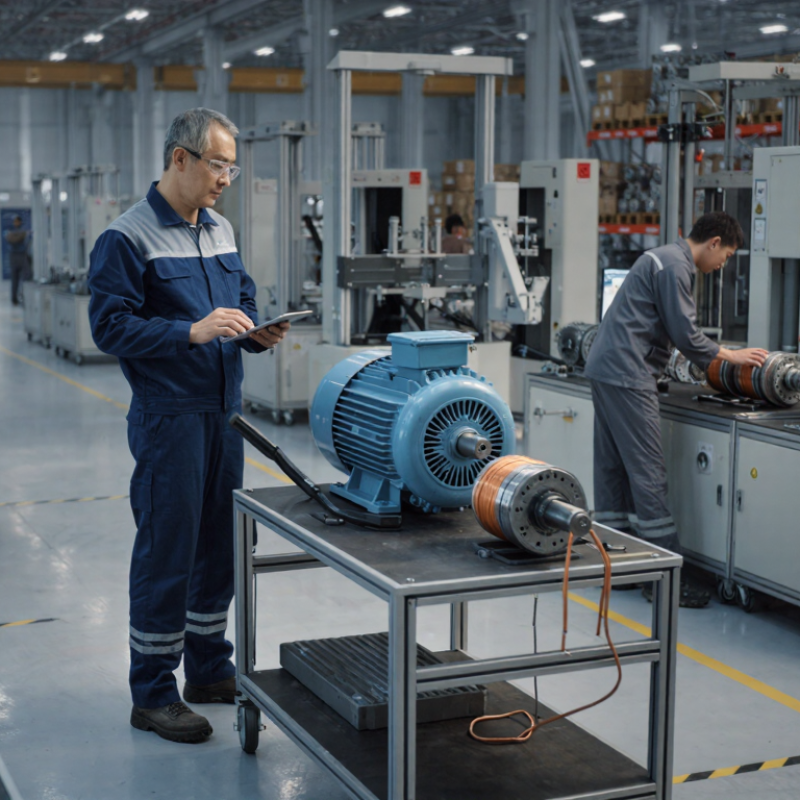
Henry Ford, an influential automotive manufacturing pioneer, said, “Quality means doing it right when no one is looking.” This principle remains useful when assessing motor manufacturers. A serious factory should provide clear drawings, material specifications, insulation grades, and test records. During a site visit, inspect copper winding equipment, rotor balancing machines, assembly lines, and finished-motor storage. Ask to see vibration, temperature-rise, noise, and load-testing procedures. Small details matter, such as labeled cables, sealed bearings, and clean workstations.
Reliable sourcing also depends on evidence. Check export experience, customer references, quality certifications, and response times before signing a contract. Request production samples and compare their measured output with the approved specification. A supplier may present impressive certificates, yet daily production can still be inconsistent. This is where many buyers become too confident.
No checklist is perfect. Supplier performance can change after the first order. Regular inspections, clear acceptance standards, and documented communication reduce that risk. The strongest partnership grows through technical transparency, not promises alone. For buyers seeking dependable Motor Work products, patience, verification, and honest questioning create a safer path toward consistent quality.
A reliable motor supplier search begins with a precise requirement, not a low quotation. Define voltage, rated power, torque, speed, duty cycle, and installation space. Include the load profile, such as starting torque and daily operating hours. Measure the load. Guesswork can produce costly failures.
Environmental details matter too. State the working temperature, humidity, dust exposure, and required protection level. For outdoor equipment, corrosion resistance and sealing performance deserve clear limits. Specify noise, vibration, efficiency, insulation class, and acceptable tolerances. Request test methods, inspection records, and traceability for critical parts. Vague words like “premium quality” rarely support a fair comparison.
I once reviewed a motor specification that omitted starting conditions. The motor passed a basic bench test but struggled under real machinery loads. That mistake changed my review process. Ask for a sample, a dimensional drawing, and a written quality plan. Check whether production tests match the agreed criteria. Keep records. Factory audits can also examine winding work, balancing equipment, calibration dates, and final inspection areas. A supplier should explain failures openly, not hide behind attractive certificates. Even experienced buyers miss details. The specification may need revision after field testing. That is normal. Reliable cooperation grows from measurable requirements, honest evidence, and controlled changes.
| Evaluation Dimension | Motor Requirement or Quality Standard | Practical Reference Data | Recommended Verification Evidence |
|---|---|---|---|
| Application and Load | Define the driven equipment, operating mode, load profile, and starting condition before requesting quotations. | Record continuous, intermittent, peak, and starting loads. Select the motor using the actual duty cycle rather than rated power alone. | Application questionnaire, load calculation, duty-cycle description, and approved motor sizing sheet. |
| Motor Type | Choose the motor construction according to speed control, maintenance, torque, and efficiency requirements. | Three-phase induction motors are commonly used for fixed-speed industrial drives; BLDC and permanent-magnet motors support efficient variable-speed operation; servo motors are used where precise motion control is required. | Technical data sheet identifying motor topology, rotor construction, control method, and intended operating conditions. |
| Rated Power and Torque | Specify rated output, rated torque, overload torque, and acceleration requirements. | For a rotating load, approximate torque can be calculated as: T = 9550 × P ÷ n, where T is torque in N·m, P is power in kW, and n is speed in r/min. | Motor curve showing torque-speed characteristics, rated output, peak torque, and acceleration performance. |
| Voltage and Frequency | Match the motor to the available electrical supply and controller output. | Specify rated voltage, phase configuration, frequency, connection method, and allowable voltage or frequency tolerance. Common industrial systems use three-phase AC supplies, but the exact values must be confirmed for the installation. | Nameplate sample, electrical schematic, winding connection diagram, and routine voltage test record. |
| Speed and Speed Control | Define rated speed, operating speed range, acceleration time, and required speed stability. | Induction motor speed is related to supply frequency and pole count. Variable-frequency operation requires confirmation of cooling, insulation, bearing, and low-speed torque performance. | Speed-torque curve, no-load speed test, loaded speed test, and controller compatibility statement. |
| Duty Rating | Specify the operating duty according to the actual work cycle. | IEC 60034-1 defines duty types including S1 continuous duty, S2 short-time duty, and S3 intermittent periodic duty. S1 should not be assumed when the motor operates intermittently or under repeated overload. | Declared duty rating, thermal calculation, temperature-rise test report, and duty-cycle validation. |
| Efficiency | Set a minimum efficiency target suitable for the operating hours and energy cost. | Efficiency should be compared at rated load and relevant partial-load points. For regulated products, confirm the applicable efficiency classification and test method, such as IEC 60034-30-1 for AC motors. | Efficiency test report, input-output power data, rated-load test results, and applicable efficiency classification. |
| Power Factor and Current | Check power factor, rated current, locked-rotor current, and starting method. | Starting current can be several times the rated current for an induction motor, depending on the design. The electrical system and protection devices must be sized accordingly. | Routine test sheet listing rated current, no-load current, locked-rotor current, and power factor. |
| Ingress Protection | Select an enclosure suitable for dust, water, washdown, and outdoor exposure. | IP54 provides limited dust ingress protection and protection against water splashes. Higher ratings such as IP55 or IP66 provide greater protection, but the correct rating depends on the installation environment. | Enclosure rating declaration, dimensional drawing, sealing inspection record, and applicable IP test report under IEC 60529. |
| Insulation System | Confirm insulation class, temperature rise, voltage stress, and compatibility with a variable-frequency drive. | Class F insulation has a 155°C maximum insulation-system temperature rating, while Class H has a 180°C rating. The permitted temperature rise and ambient conditions must also be considered. | Insulation resistance test, high-potential test, winding material specification, and thermal classification declaration. |
| Ambient Conditions | Define ambient temperature, altitude, humidity, corrosive exposure, and ventilation conditions. | Standard ratings are commonly based on a defined ambient condition, often around 40°C. Higher altitude or temperature can reduce cooling and may require derating or a larger motor. | Derating curve, cooling calculation, environmental specification, and final inspection checklist. |
| Mechanical Interface | Specify mounting arrangement, frame size, shaft dimensions, keyway, flange, and allowable radial or axial load. | IEC 60072 provides dimensional guidance for electrical machines. The shaft and mounting dimensions must be matched to the driven equipment before production approval. | Certified dimensional drawing, shaft runout measurement, mounting inspection report, and sample fit-check record. |
| Bearings and Lubrication | Define bearing type, expected service life, lubrication method, and maintenance interval. | Bearing selection depends on speed, radial load, axial load, temperature, and installation orientation. High-speed or inverter-driven applications may require additional bearing-current controls. | Bearing specification, lubrication instructions, vibration test results, and bearing temperature test data. |
| Noise and Vibration | Set acceptable acoustic noise and vibration limits for the installation. | Noise and vibration depend on speed, balance, bearings, fan design, mounting, and load. Testing should be performed at defined speed, load, and measurement positions. | Noise measurement record, vibration measurement record, rotor-balance report, and acceptance limits based on the applicable standard. |
| Thermal Protection | Protect the motor against overload, locked rotor, excessive temperature, and insufficient cooling. | Possible devices include thermal switches, thermistors, resistance temperature detectors, or electronic overload protection. The sensor type and trigger point must be identified. | Protection circuit diagram, sensor calibration record, overload-trip test, and temperature-rise report. |
| Quality Control | Require documented inspection at incoming material, in-process, and final testing stages. | Core checks commonly include winding resistance, insulation resistance, high-potential withstand, no-load current, speed, vibration, noise, and appearance. | Inspection and test plan, batch traceability records, calibration certificates, and signed final test report. |
| Sample Approval | Approve a representative production sample before mass production. | Test the sample under the actual voltage, frequency, controller, load, mounting arrangement, and environmental conditions whenever possible. | Golden-sample approval record, signed specification, performance test results, and deviation-control procedure. |
| Supplier Reliability | Evaluate technical capability, production consistency, communication, traceability, and after-sales support. | Reliable evaluation should cover factory process controls, testing capability, change management, spare-parts support, lead-time performance, and corrective-action response. | Factory audit checklist, process flow, quality certificates, corrective-action records, production capacity statement, and warranty terms. |
| Packaging and Delivery | Protect the motor from moisture, impact, corrosion, and shaft damage during storage and transport. | Packaging should secure the rotor and shaft where necessary, prevent condensation, identify lifting points, and include clear model, quantity, and handling information. | Packaging specification, drop or transport evaluation, moisture-control procedure, and pre-shipment inspection photographs. |